
GMC’s Wild Shot At High-Performance Trucks
[ad_1] We take for granted the sheer number of performance trucks and SUVs on the market today. Stroll down to any dealership, and you’ll quickly be amazed at all the high-horsepower family haulers, not to mention pickup trucks that can tackle a massive jump with ease, such as the Ford F-150 Raptor. Performance has been
[ad_1]
We take for granted the sheer number of performance trucks and SUVs on the market today. Stroll down to any dealership, and you’ll quickly be amazed at all the high-horsepower family haulers, not to mention pickup trucks that can tackle a massive jump with ease, such as the Ford F-150 Raptor. Performance has been democratized, but there was a time when vehicles like this were practically unheard of from the factory, until GMC was brave enough to break the mold.

GMC
- Founded
-
1911
- Founder
-
William C Durant
- Headquarters
-
Detroit, Michigan
- Owned By
-
General Motors
- Current CEO
-
Mary Barra
Yes, Chevrolet’s upscale, utilitarian counterpart decided to take a big swing in the early ’90s by creating a high-performance truck and SUV based on the GMC Sonoma. Dubbed the Typhoon and Syclone, they were a tropical whirlwind that took the world by storm, hitting the market and immediately embarrassing vehicles three times their price. They were a shock to the senses, and as soon as they arrived, they disappeared, but not before leaving a path of destruction in their wake that we’re still experiencing to this day.
We explore the creation of the two hurricane-inspired models, and the exceptional performance and style they packed, before looking at why they disappeared and the legacy they forged.
GMC Took a Wild Shot at High-Performance Trucks
The late ’80s saw the truck and SUV markets in the US grow significantly. People appreciate practicality, and both offered you a vehicle that could handle a wide range of tasks with ease. More importantly, both were also getting more luxurious and comfortable, making them more reasonable options as daily drivers. The only place that hadn’t been explored yet was the performance world, and GMC was ready to fix that at the start of the ’90s.
A group of engineers got together in 1987 with the bright idea of creating a Buick Grand National pickup truck. A Chevy S-10 was chosen, and the engine was installed along with looks and other performance upgrades. While this is easily one of the coolest things we’ve ever heard, GM executives weren’t sold. However, GMC understood the opportunity it presented, and went to work creating its own sport truck creation with a cheaper 4.3-liter Vortec V6 from Chevy instead.

Related
The Most Awesome Factory Performance Trucks Of All Time
Occasionally, mainstream OEMs go wild and put the sportiest parts on the heaviest models. These are some of the coolest high-po pickups ever built.
Of course, a project like this needed the right expertise, which is why GMC contracted the help of Production Automotive Services, Inc. (PAS) to build it. This company had been working on fitting the 1989 Pontiac Turbo Trans Am with the Grand National’s engine to celebrate its 20th anniversary. After that project wrapped, its eyes were set on this new sports truck project, and the plan it laid out was a doozy.
The truck would be based on the GMC Sonoma pickup, the platform mate of the Chevy S-10, and it was to be given a potent turbocharged powertrain, AWD, handling upgrades, and great looks to pull new customers into the showrooms. It was going to be a whirlwind of performance, so naming it the “Cyclone” would made sense. However, the big mystery comes from changing the “C” to an “S”, creating the GMC Syclone. Perhaps the company wanted a connection to the Sonoma, or maybe it was trying to avoid a trademark dispute, but whatever the reason, there’s no denying “Syclone” looks a little bit cooler.
The pickup arrived in 1991, with the Typhoon SUV arriving a year later. It was based on the GMC Jimmy, which was just a Sonoma with a roof in the rear and extra seats. It made sense to offer them both, as it expanded buyer options, and the division was prepared to build as many of them as customers were willing to buy.
Category 5 Supercar Killers
GMC didn’t have an unlimited budget to create the SyTy twins, so, unsurprisingly, the models benefited quite a bit from parts sharing. First, GMC was focused on acceleration, which is why the models were fitted with an AWD system straight out of the GMC Safari van with a Borg-Warner transfer case that sent 35% of the available torque to the front wheels and 65% to the rears. The torsion bar front suspension also came from the AWD model, but the rest was pretty standard ’80s truck fare, save for lowered, stiffer springs and additions like 1.26-inch sway bars. Interestingly, the Typhoon received adjustable rear air suspension to improve its loadability with added passengers, but this wasn’t used in the Syclone.
The AWD system only added about 200 lbs to each vehicle, and engineers said at the time that it only led to a 4% powertrain loss. Along with four-wheel anti-lock brakes, a 3.42:1 limited-slip rear differential, and 245/50VR16 Firestone Firehawk SZX tires, they had everything necessary to utilize the impressive new power of the turbocharged 4.3-liter V6.
Performance Comparison: GMC vs Period Icons
|
Spec |
1991 GMC Syclone |
1992 GMC Typhoon |
1990 Ferrari 348 |
1991 Porsche 911 Carrera 2 |
1991 Corvette ZR-1 |
|---|---|---|---|---|---|
|
0–60 mph |
4.3 seconds |
5.3 seconds |
5.6 seconds |
5.4 seconds |
4.9 seconds |
|
Quarter-Mile |
~13.4 seconds |
~14.1 seconds |
~14.1 seconds |
~13.9 seconds |
~13.2 seconds |
|
Horsepower |
280 hp |
280 hp |
296 hp |
247 hp |
375 hp |
|
Drivetrain |
AWD |
AWD |
RWD |
RWD |
RWD |
The engine saw the addition of a Mitsubishi turbocharger with a water-cooled center housing for greater durability. The engine received upgrades to its pistons, intake and exhaust manifolds, multipoint fuel injection, intercooling, and the throttle body out of the 1992 Corvette 5.7-liter V8. All of that power was sent through a Corvette TH700-R4 four-speed automatic transmission and sent to two 2.25-inch exhausts that obviated the use of mufflers.

Related
1992 GMC Typhoon Blessed With 1,500-HP LS V8
That’s probably enough power for a ’90s SUV.
In the end, the vehicles both made 280 horsepower and 350 lb-ft of torque, enough to launch the Syclone to 60 mph in just 4.3 seconds on the way to a quarter mile in the mid-13-second range. Thanks to weighing a few hundred pounds more, the Typhoon did the job in about 5.3 seconds and the quarter mile in about 14 seconds. However, it’s important to note that the Syclone’s times were optimistic, and real-world testing saw it, too, fall into the five-second range.
However, no matter how you look at it, this kind of performance in the early ’90s from a pickup truck and SUV was downright brutal. This performance was enough to help the two models out-accelerate contemporary vehicles like the Mustang GT and Ferrari 348ts. Its showdown with the Ferrari was immortalized in one of the greatest Car and Driver articles of all time.
They could also outbrake the Ferrari too, and they were only a hair slower than vehicles like the Acura NSX. Sure, throw in a curve or two, and the charade falls apart, but there’s no denying these were world-shattering feats from entry-level SUVs and pickups.
A Tropical Storm Of Style, Presence, and Practicality
Beyond the power, the Syclone and Typhoon also stood out thanks to their gorgeously subtle new looks. Obviously, they both sat lower to the ground, but GMC visually lowered them even further thanks to the addition of a new front fascia with integrated fog lights at each corner, new fenders and rocker panels that gave them a new aerodynamic shape, and rear bumpers that tied them all together.
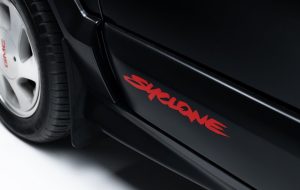
Both sat on 16-inch aero-style alloy wheels, and they featured awesome decal packages that emblazoned the names in attractive script across many different areas of the vehicles. The decals were gold on the Typhoon and red on the Syclone. The red continued to the interior on the Syclone, with black cloth seats with red stitching that made the interior pop, with “Syclone” spelled out on the headrests.
The Typhoon was a little more luxurious, with the addition of leather seating that coddled the driver thanks to lumbar support and six-way power adjustability. Things like power locks and keyless entry came on the Typhoon, while the Syclone was more bare-bones. However, a cool addition was a gauge cluster out of the Pontiac Sunfire Turbo GT, which added boost and oil pressure gauges among others, and read all the way up to 120 mph.

Related
10 Cool Trucks That Rule The Road
From classic trucks to modern wonders, there have been some seriously cool pickup trucks on American roads.
For 1991, the Syclone was only available in Midnight Black, with further colors set to arrive in 1992 before it was canceled. The Typhoon, however, received tons of colors, including:
- Forest Green Metallic
- Royal Blue Metallic
- Frost While
- Raspberry Metallic
- Aspen Blue
- Radar Blue
- Apple Red
- Bright Teal
- Garnet Red.
No special edition Typhoons were ever made, but the Syclone had a few. First, about 150 Syclones were modified and shipped to Saudi Arabia for sale, with 30 making it back to the US. Marlboro modified ten for a contest in 1992, going as far as to give the trucks targa roofs, and three were modified as pace cars for the 1992 Indy 500, with only one receiving a full paint job by PPG.
A Lightning Strike That Tragically Never Hit Twice
While headline-stealing models, it was quickly apparent that the market for such products simply wasn’t there. In one year of production, 2,995 Syclones were sold, with three more sold in 1992 when it was canceled. The Typhoon received a two-year production run, and, over the course of that, 4,697 of them were sold. We don’t know how many GMC was hoping to sell, but given the quick cancellation of both and no plans for successors, it’s easy to assume it was a good bit more than that.
Despite the very positive press, it appears buyers weren’t drawn to the vehicles for a few reasons. First, the vehicles weren’t cheap, with the Typhoon starting at $29,530 and the Syclone starting at $25,970, both of which were more expensive than the Chevy 454 SS. They countered this price thanks to including so much performance and style in each package, but those packages couldn’t tow or go off-road, and the payload rating for the Syclone was a mere 300 lbs.

Related
The 750-Horsepower GMC Syclone Costs More Than A 911
But it’s arguably even more special.
Unfortunately, they were just a bit ahead of their time, but many pioneers are. Their legacy now looms large for plenty of reasons:
- Short production runs make both models highly collectible.
- They introduced America to the concept of performance trucks/SUVs.
- Their acceleration was world-beating.
- GMC has never produced anything like them since.
- They inspired a generation of fast utility vehicles.
Due to all of these reasons and more, current SyTy models now fetch hefty sums on the open market. Given the condition and miles, you can expect to spend anywhere between $30,000 and $40,000, with the Syclones fetching a little bit more due to their rarity. These prices can go through the roof for particularly clean and low-mileage examples.
They came, they went, and they left a path of destruction in their wake. They’re easily some of the coolest production vehicles ever made, and we hope GMC sees the light and gives them a revival.
Sources: GMC.
[ad_2]
منبع:carbuzz
برچسب ها :
ناموجود- نظرات ارسال شده توسط شما، پس از تایید توسط مدیران سایت منتشر خواهد شد.
- نظراتی که حاوی تهمت یا افترا باشد منتشر نخواهد شد.
- نظراتی که به غیر از زبان فارسی یا غیر مرتبط با خبر باشد منتشر نخواهد شد.
ارسال نظر شما
مجموع نظرات : 0 در انتظار بررسی : 0 انتشار یافته : 0